
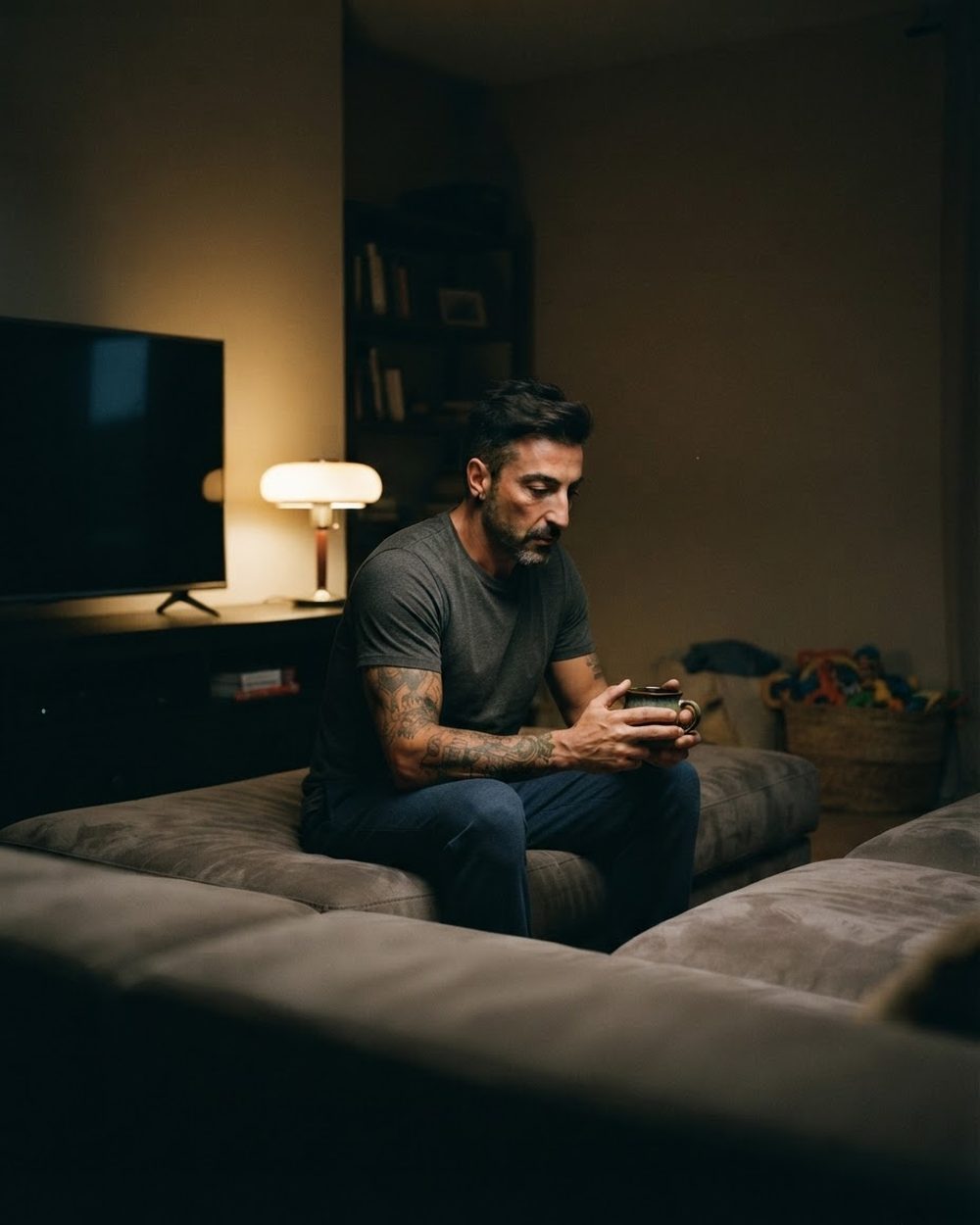
Why Dads Get Lonely After Kids — And Lose Their Friends
The loneliness of fatherhood nobody talks about. Why dads lose friends, feel isolated, and what it actually takes to rebuild connection after kids.
Last Saturday night I stood at the kitchen sink rinsing sippy cups at 8:14pm while a group chat I used to be in lit up with photos from a rooftop bar downtown. Seven guys. Drinks I used to order. A city I used to live in — same city, different planet. I dried my hands, put the phone face-down on the counter, and sat on the couch in a house that was finally quiet. Both kids asleep. Partner asleep. Me, awake, in a silence that should have felt like relief but felt like something else entirely.
The Friendships That Disappear
It starts with logistics. You cancel plans because one of the kids has a fever. You cancel again because you're too wrecked from a night of interrupted sleep to sit upright at a restaurant. You cancel a third time because the babysitter fell through and you can't justify the cost of another one for a dinner you'll be too tired to enjoy.
Then you stop getting invited.
Not because anyone is angry. Because the algorithm of friendship runs on reciprocity, and you've been withdrawing from the account for months. Your friends without kids don't understand why you can't just "figure it out." Your friends with kids are running the same deficit and don't have the bandwidth to reach out either.
Within a year of becoming a dad, I'd lost contact with most of my close friends. No fights. No falling outs. Just a slow, quiet drift into parallel lives that used to intersect and don't anymore. The group chat still exists. I just stopped being the person who responds.
The Loneliness Nobody Prepared Me For
There's a specific kind of isolation that comes with early fatherhood, and it's not the kind you can solve by "getting out more." It's structural. Your schedule doesn't align with anyone else's. Your energy peaks at 6am and craters by 7pm. The things you used to bond over — late dinners, weekend trips, spontaneous plans — require a level of logistical planning that makes them feel like work instead of relief.
That's the part nobody talks about. Not the sleep deprivation. Not the mental load. The fact that you can be surrounded by people — your kids, your partner, other parents — and still feel profoundly, quietly alone. The loneliness isn't about being by yourself. It's about being with people who need things from you and having no one who asks how you're doing.
The blog was the beginning. The book is the whole story.
Everything here started in my parents' basement at 3am. The Dad Diaries — the failed transfers, Kenya, the citizenship fight, and the postpartum depression nobody warns a father about — is published by Cormorant Books on 26 September.
Why Dads Don't Talk About It
Moms have playgroups. Mom friends. Online communities where vulnerability is the currency of entry. Entire industries built around the idea that motherhood is hard and you deserve support.
Dads have the nod at the playground. The awkward small talk at school pickup. The guy at work who also has kids and occasionally says "hanging in there?" in the elevator.
Men are socialized to connect through activities — sports, work, going out. When kids remove those activities, the connections go with them. And admitting you're lonely as a dad feels like admitting you're failing at something you're supposed to handle without help. The word "lonely" itself feels like a confession. Dads don't say it. They say "busy." They say "tired." They say "fine." All of which are true, and none of which are the whole truth.
There's also a gendered invisibility to it. When a mom says she's struggling, the response is empathy. When a dad says it, the response is often comparison: "Imagine how your wife feels." As if struggle is a competition with a fixed number of seats, and yours isn't valid because someone else has it harder.
So you stop saying it. You perform competence. You scroll your phone after bedtime and call it decompression. And the gap between how you look and how you feel gets wider every week.
The Physical Shape of Dad Loneliness
Loneliness in fatherhood doesn't look like sitting alone in a dark room. It looks like being at a birthday party surrounded by other parents and not having a single real conversation. It looks like pushing a double stroller through a park on a Sunday morning, passing other families, and feeling like you're watching life through a window.
It looks like the third Tuesday in a row where the only adult conversation you've had is with a cashier at the grocery store. It looks like opening a text thread with an old friend, typing something, deleting it, and putting the phone away.
One night — maybe three months into the twins' first year — I was folding laundry on the living room floor at 9:40pm. A basket of tiny onesies, mismatched socks, burp cloths. The TV was off. The house was dark except for the lamp next to me. I realized I hadn't spoken to another adult outside of a transactional context in four days. Not a real conversation. Not one where someone asked me something and waited for the answer.
I finished the laundry. I went to bed. I didn't tell anyone about it because I didn't have anyone to tell.
That's what the invisible weight of fatherhood looks like when it compounds. It's not just the tasks. It's the silence around them.
What Loneliness Does to Your Parenting
Here's the part that matters most and gets discussed least: lonely dads are worse dads. Not because they love their kids less. Because isolation depletes the exact resources you need to parent well — patience, emotional regulation, the ability to be present instead of just proximate.
When you're running on empty socially, your fuse gets shorter. The overstimulation hits harder . The bedtime routine that should take twenty minutes feels like it takes an hour. You snap at things that don't deserve snapping. Then you feel guilty, which makes you withdraw further, which makes you lonelier. The spiral is real, and it feeds directly into the kind of depletion that takes months to climb out of.
Loneliness isn't a lifestyle inconvenience. It's a parenting risk factor. And treating it like something dads should just tough out is how you end up with fathers who are physically present and emotionally gone.
What Actually Helps
I'm not going to pretend I've solved this. I haven't. But I've learned a few things that moved the needle.
Be the one who reaches out first. Not waiting for invitations. Sending the text. Making the plan. Even when it feels awkward, even when you're not sure the other person wants to hear from you. The dads I know who are least lonely are the ones who stopped waiting for connection to come to them.
Find one person. Not a community. Not a support group. One other dad who gets it. Who you can text at 10pm and say "today was brutal" without having to explain what you mean. That one person changes everything. The loneliness shrinks the moment it's shared.
Lower the bar for what counts as connection. It doesn't have to be a night out. A fifteen-minute phone call while you're both driving counts. A voice note counts. Sitting next to another dad at a kids' soccer game and actually talking instead of staring at your phone counts.
Stop performing fine. The next time someone asks how you're doing, try the honest answer. Not the dramatic version. Just the real one. "I'm tired and I miss my friends." You'll be surprised how many dads are waiting for someone else to say it first.
Accept that your social life will look different. Not worse — different. The 10pm dinners become 10am playground hangs. The spontaneous road trips become planned family outings. The quality of connection matters more than the quantity, and the connections you build now — forged in the shared chaos of raising small humans — are often deeper than the ones you lost.
Frequently Asked Questions
Is it normal for dads to feel lonely after having kids?
Yes — it's extremely common, and almost nobody talks about it. New fathers often experience real social isolation, in part because there are far fewer support structures built for dads than for moms. The loneliness is real, common, and rarely named out loud.
Why do dads lose friends after having kids?
Logistics, mostly. Your schedule changes, your energy changes, your priorities change. Friendships built on shared activities — going out, sports, spontaneous plans — lose their foundation when kids arrive. The drift is gradual, which makes it harder to notice until it's already happened.
How is dad loneliness different from mom loneliness?
The support infrastructure is the big difference. Moms have playgroups, online communities, and cultural permission to say "I'm struggling." Dads have almost none of that. The expectation is that dads handle it quietly, which deepens the isolation.
What's the connection between dad loneliness and burnout?
They feed each other. Loneliness depletes your emotional reserves, which makes parenting harder, which makes you withdraw further, which makes you lonelier. Breaking the cycle usually takes one small act of connection — reaching out, being honest, or finding one other dad who gets it.
Does dad loneliness go away as kids get older?
It can improve, but it doesn't resolve on its own. The logistics ease as kids get more independent, but the friendships you lost don't rebuild themselves. Rebuilding takes intentional effort — and the dads who start earlier tend to recover faster.

Joseph Tito
Creator of The Dad Diaries. Gay dad of twins. Writing about fatherhood, surrogacy, and the beautiful mess of real life.
Join the newsletter
The real stuff, in your inbox
Stories from a gay dad raising twins. No advice you didn't ask for, no sponsored content — just honest modern fatherhood.